Why DSPs Reject DDEX Releases (and How to Fix Them)
Why DSPs reject DDEX releases: metadata errors, cover art policy, audio problems and ERN version mismatches, and how to catch each one before delivery.
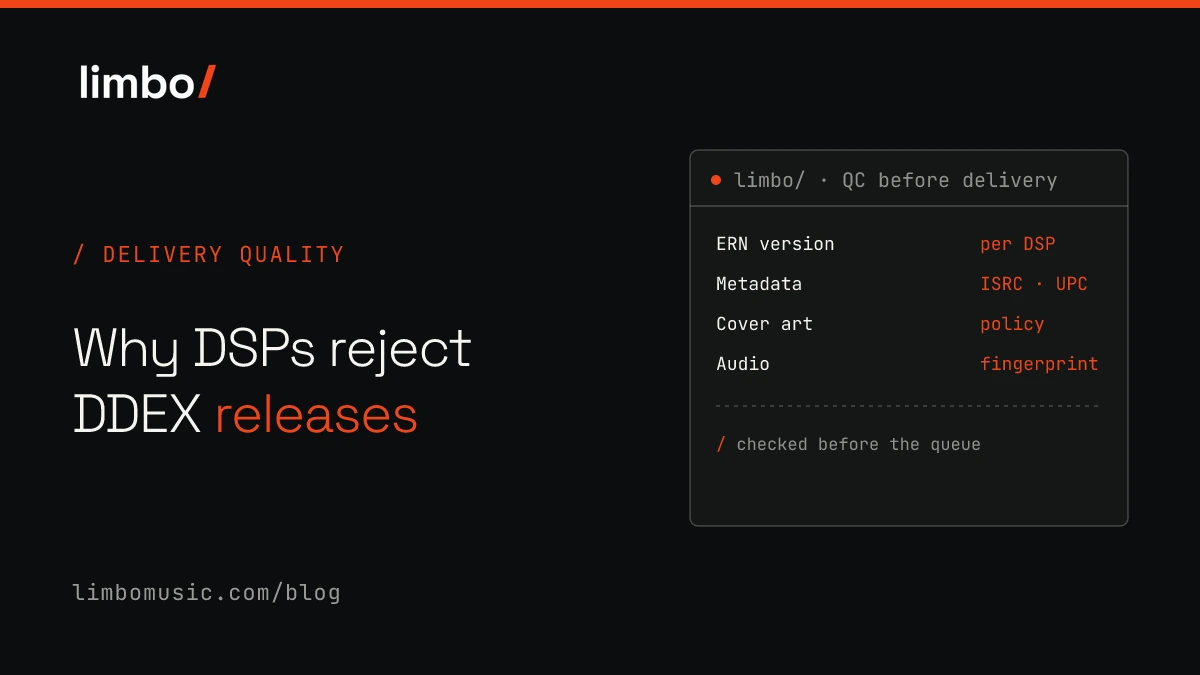
DSP rejections are one of the most frustrating parts of music distribution: the release looks complete, the DDEX package is queued, and then it comes back with an error or never shows up at all. Most rejections happen at predictable checkpoints, across three layers: the cover image, the metadata and the audio.
Short answer: DSPs reject DDEX releases because of metadata errors (a wrong ISRC, a bad UPC check digit, a missing P-line), cover art that breaks store policy (embedded promotional text, logos, explicit imagery), audio problems (silence, clipping, lossy artifacts, fingerprint conflicts), or a mismatch between the ERN version you sent and the one the platform expects. A structured quality-control pass before delivery catches most of them before the package ever leaves your system.
What happens when a DSP rejects a DDEX delivery
When a DSP receives a DDEX package, it validates it against the version of the standard it supports and against its own content policies. If the package fails, the DSP returns a rejection, sometimes with a reason code and sometimes without much detail.
Silent failures are the worst kind: the release never appears in the store and nothing shows up in your dashboard unless your delivery layer is built to catch it. limbo/Distribution validates every release before it enters the queue, so a broken submission fails in seconds with line-level reasons instead of disappearing downstream.
ERN version mismatches
Sending the wrong ERN version is one of the fastest ways to get rejected. DSPs have not all moved to the same version of the standard, so a package built for ERN 4.3 can be refused by a platform that still expects 3.8.2, and the other way round.
| Scenario | Risk | Fix |
|---|---|---|
| ERN 4.3 sent to a DSP that expects 3.8.2 | Rejected at ingestion | Choose the version per DSP |
| ERN 3.8.2 sent to a DSP that requires 4.3 | Fails validation | Choose the version per DSP |
| One version sent to every DSP | Rejected wherever that version is not accepted | A per-DSP protocol map |
limbo/ delivers ERN 4.3 and 3.8.2 and picks the right one for each DSP automatically, so a single release never goes out in the wrong version.
The metadata errors that trigger rejections
Metadata is usually the first automated check, and it covers more fields than most teams expect. One malformed value is enough to reject the whole package:
- ISRC errors: the wrong format, or the same ISRC reused across different tracks.
- UPC check digit failures: the last digit is calculated from the others, so one typo fails validation.
- Missing or malformed P-line and C-line: the year and rights holder must be present and correctly formatted.
- Version tags: remix, live or instrumental versions have to use the wording each store expects.
- Multi-language metadata: titles in non-Latin scripts that fail spelling or encoding checks.
- Technical spec mismatches: a sample rate, bit depth or format in the XML that does not match the file actually delivered.
Agent Quality Control checks titles, ISRC, UPC and check digits, version tags, P-line and C-line, advisory fields, spelling across Latin and non-Latin scripts, and technical specs before anything ships.
The cover art problems that block a release
Cover art is checked for format and for content. A file can pass the format check and still be refused for what it shows:
- Content policy: explicit imagery, violence or hate symbols.
- Embedded text and logos: website URLs, social handles or third-party logos on the artwork.
- Promotional text: phrases like “free download” or “out now”, or prices.
- Likeness of a known person used without clearance.
- Format: the wrong resolution, color space or file size for the store.
Agent Quality Control runs content moderation, text and logo detection (OCR), promotional-element checks, artist and celebrity matching, and format and store-policy checks on every cover.
The audio problems that cause rejections or takedowns
Audio problems can stop a release before delivery or take it down after it is live, which does more damage. Both are avoidable with a check before delivery:
- Silence: long leading silence, or tracks that are entirely silent.
- Long intros and spoken word: some stores flag tracks where the music starts too late.
- Clipping and codec artifacts: audio that clips, or carries artifacts from repeated lossy encoding.
- Fingerprint conflicts: a match with a previous release, a known sample or a shared beat can lead to a rejection or a claim.
- AI-generated audio: stores are tightening their policies on AI-generated music, so it pays to know what you are sending before you send it.
Agent Quality Control runs silence and long-intro detection, audio quality scans for clipping and codec artifacts, fingerprint matching against a global catalog (covers, samples, shared beats, earlier releases) and AI-generated music detection.
How to catch all of this before the release ships
The reliable approach is one quality pass over all three layers before the package is queued. Waiting for DSP feedback costs days and can cost you the release date. A good pass:
- Checks the cover: content, embedded text, promotional elements, likeness, format.
- Checks the metadata: ISRC, UPC, P-line and C-line, version tags, spelling, technical specs.
- Checks the audio: silence, clipping, codec quality, fingerprints, AI-generated content.
- Compares every finding with the delivery rules of each DSP the release is going to.
- Produces a ranked report that says what is wrong, how serious it is and why.
That is what Agent Quality Control does on every limbo/ release: a multimodal AI reads the report and the cover together and checks each finding against an up-to-date library of store delivery rules for Spotify, Apple Music, YouTube, Merlin and more. At catalog scale, consistency matters as much as coverage: manual review drifts from one reviewer to the next, and an agent applies the same rules every time.
How long redelivery takes after a fix
Redelivery follows the same pipeline as the first delivery. On limbo/, delivery is guaranteed in under 24 hours once the release passes quality control, and up to 48 hours when the content needs another correction. Each DSP then ingests on its own schedule. See how long DDEX delivery takes for the full timeline.
Next steps
Most DDEX rejections are preventable: a malformed field, a cover that breaks a store rule, an audio fingerprint conflict, or the wrong ERN version. Catching them before the package ships is faster and less damaging than waiting for a store to tell you.
If you run a label, a distributor or a music-tech product, limbo/Distribution validates every release before it is queued and picks the right ERN version per DSP, and Agent Quality Control checks image, metadata and audio against each store’s rules. Talk to limbo/.
Keep reading: what DDEX is · DDEX 4.3 vs 3.8.2 · how long DDEX delivery takes