Who Owns Your Music Distributor? The 2026 Ownership Map
Who owns DistroKid, FUGA, The Orchard and CD Baby in 2026. The ownership map of music distribution, and why it decides who sees your label's numbers.
The question nobody asks until it is too late
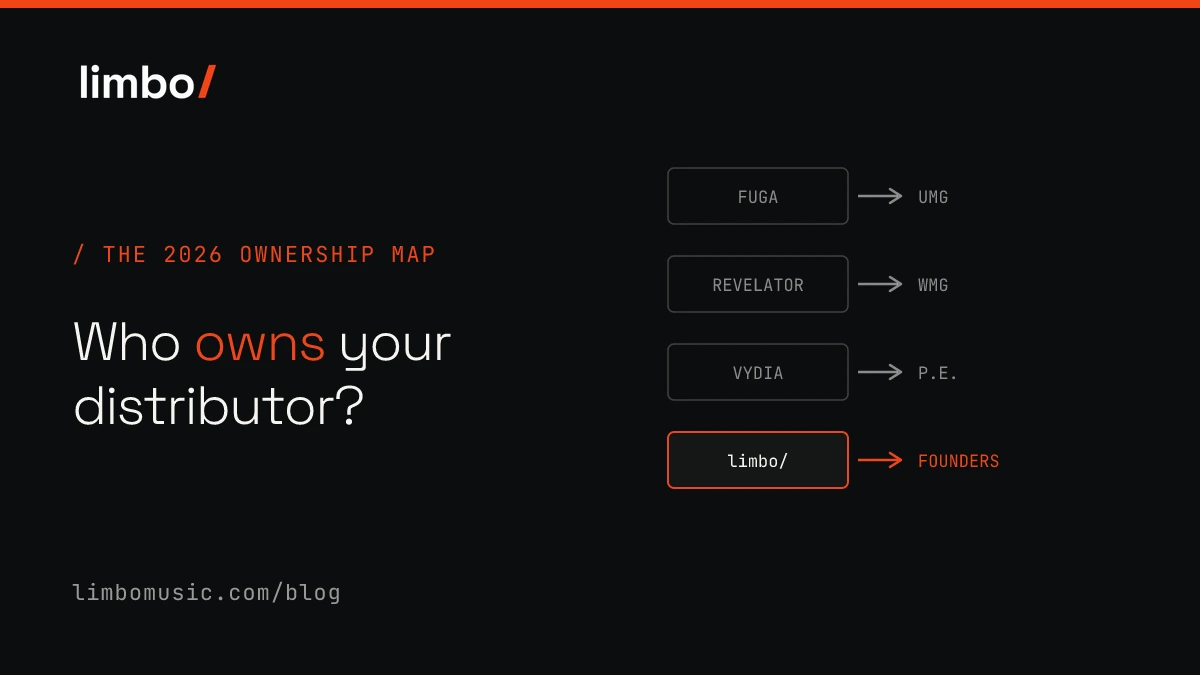
In 2026, most “independent” B2B distribution platforms are not independent: FUGA belongs to Universal, Revelator is being acquired by Warner, and several others answer to private equity. If your label or distribution company runs on one of these platforms, your release schedules, revenue and roster strategy flow through infrastructure owned by someone with their own agenda. That is the single most underrated question when choosing a distribution partner: not “what features,” but “who owns the pipes.”
Here is the map, from public reporting, and what to do with it.
The 2026 ownership map
FUGA → Universal Music Group. FUGA’s parent, Downtown Music Holdings, was acquired by UMG in a $775 million deal that closed in early 2026. The European Commission ran a Phase II review over one concern: UMG gaining access to competitors’ commercially sensitive data. If you distribute through FUGA, the largest major on earth now sits upstream of your business. Full analysis: the independent FUGA alternative.
Revelator → Warner-linked. Warner Music Group has moved to acquire Revelator, the white-label and API platform. Same pattern, different major. Details: the independent Revelator alternative.
DistroKid → Insight Partners (growth equity). The most-asked ownership question in this whole category, and the answer surprises people: DistroKid is not a scrappy independent. In 2021 the growth-equity firm Insight Partners took a majority stake in a deal reported to value the company at around $1.3 billion. A fund that size does not buy for the love of music; it buys for an exit, and the terms you sign are one of the levers on the way there.
The Orchard → Sony Music Entertainment. The Orchard has been wholly owned by Sony since 2015. It is the oldest version of this story and the clearest: if you distribute through The Orchard, a major label sits directly upstream of your release data.
CD Baby → Downtown → Universal. CD Baby belongs to Downtown Music Holdings, which is the same acquisition described above. The route is longer, the destination is identical.
Vydia → Gamma (private equity). Vydia was folded into Larry Jackson’s gamma., backed by Eldridge, Apple and A24 in a reported billion-dollar structure. Not a major label, but a fund-driven owner with fund-driven incentives.
SonoSuite → independent, with outside investment. To be fair where fairness is due: SonoSuite remains independent of the majors, with a minority outside stake. The structural questions are different there; our honest comparison is in the SonoSuite alternative breakdown.
limbo/ → its founders. 100% founder-owned since 2006, bootstrapped, zero venture capital, zero major-label money. Our clients are our investors. Not a tagline: the actual cap table.
Why ownership beats features
A platform can be excellent software and still be structurally misaligned with you the day its owner changes. Three concrete mechanisms:
Data exposure. Your streaming numbers, revenue splits and release calendar are competitive intelligence. When a major owns your distributor, that intelligence lives in their house. The EC did not open a Phase II review over nothing.
Priority drift. A distributor owned by a major or a fund optimizes for its parent’s outcomes: consolidation targets, margin extraction, exit timelines. An independent optimizes for staying in business by keeping clients happy. Incentives are destiny.
Terms over time. The acquisition press release always says “nothing changes.” Then contracts come up for renewal under a new owner with new targets. Ask anyone who lived through a platform acquisition what year two looked like.
The checklist: audit your own distributor
- Who is the ultimate parent entity, today? Not the brand: the cap table.
- Has ownership changed in the last 24 months, or is a deal pending?
- Where does your royalty and performance data physically live, and who can query it?
- What does your contract say happens on a change of control?
- Can you export your full catalog and history, cleanly, if you leave?
If any answer makes you uncomfortable, that discomfort is information.
Where limbo/ stands
We built limbo/ so the answer to every question above is boring: founders own it, royalty reporting runs on Curve, the platform Merlin co-owns, private by design, delivery runs on direct DSP contracts plus Merlin membership across 40+ platforms, and the whole thing is modular, so you take only what you need, through the white-label platform or the API.
Independent in a moment of concentration. If you are auditing your own setup, start the conversation: a short form, then a human.
If you run a label and this is the decision in front of you right now, the practical version lives on distribution for record labels: what to ask, what cannot be changed later, and what independence actually buys you.