How to Start a Record Label: A Step-by-Step Guide in 2026
What it really costs to start a record label in 2026: $100 to $500 to register, $500 to $2,000 for contracts, plus the distribution choice that is hardest to undo.
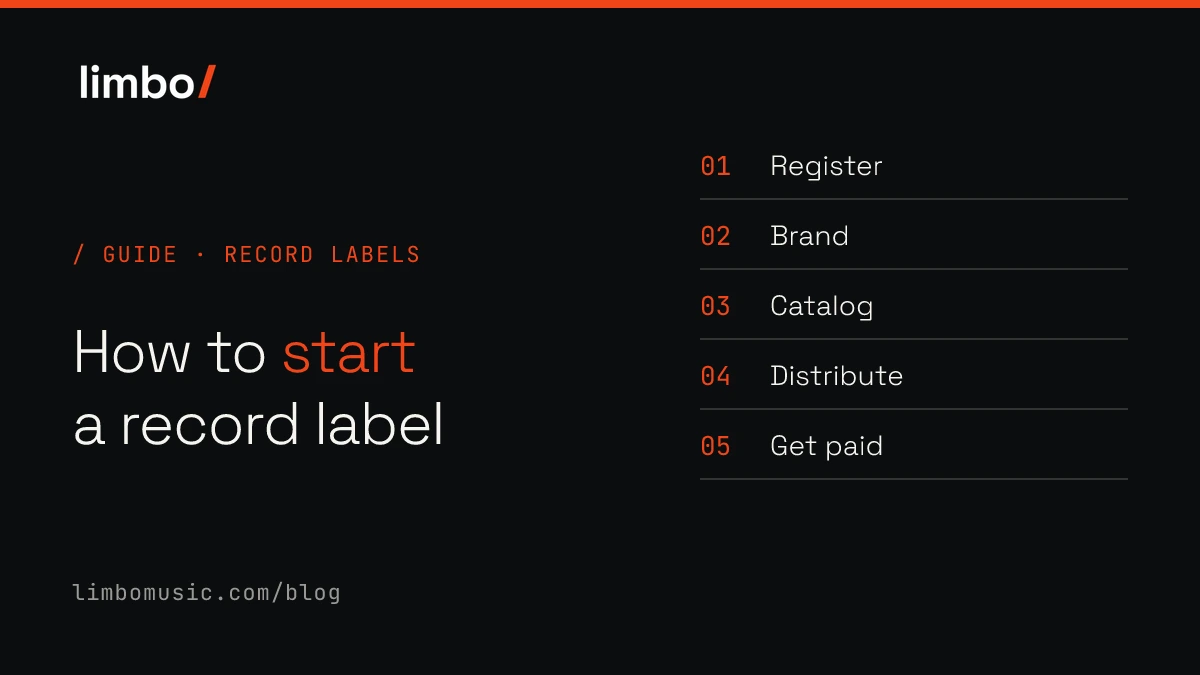
Starting a record label in 2026 takes five things: a legal entity, artist contracts, a first roster of one or two acts, a marketing plan, and a distribution setup that can grow with you. This guide walks through each step, with real cost ranges and the questions to ask before you commit to any platform.
What is a Record Label?
A record label is a company that discovers, develops, and promotes musicians by handling their music production, distribution, and marketing. Record labels invest in artists and help them reach wider audiences through professional resources and industry connections.
Three main types exist:
- Major labels: Universal, Sony, Warner (large scale, multiple sub-labels)
- Independent labels: Smaller scale, artist-friendly, creative control
- DIY labels: Artist-owned, maximum control, limited resources
How Do You Create a Record Label From Scratch?
Creating a record label follows the same six steps whether you sign one artist or fifty: register a business entity, draft your artist and distribution contracts before anyone signs, sign one or two artists to start, choose distribution infrastructure you can grow with, budget 12 months before expecting profit, and launch with a plan rather than a single release. The order matters less than sequencing it correctly: labels that sign artists or pick a distributor before the legal and contract layer is in place spend the following year fixing it.
- Register the business as an LLC or equivalent (see legal requirements below)
- Draft contracts first: recording, distribution, and work-for-hire agreements, before any artist signs
- Start with one or two artists, not a full roster
- Choose distribution infrastructure, not just a checkout button: direct DSP contracts and auditable royalties matter more once you scale past release one
- Budget for 12 months of catalog and audience building before profit
- Launch with the 30-day checklist further down this guide
If the goal is to build an independent label rather than one that ends up feeding a major-owned distribution pipeline, the distribution choice is the step that decides it: who holds the DSP relationships, who sees the royalty data, and whose roadmap you are on.
How Much Does it Cost to Start a Record Label?
Starting a record label costs between $1,000-$50,000 depending on scale. Minimum startup costs include business registration ($100-500), basic legal setup ($500-2,000), and initial marketing ($500+).
Essential startup expenses:
- Business registration: $100-500
- Legal/contracts: $500-2,000
- Distribution setup: $0-100/month
- Initial marketing: $500-5,000
- Recording fund: $1,000-10,000+
What Legal Requirements Do I Need to Start a Record Label?
You need to register as a business entity, draft artist contracts, and secure proper licenses. Start with LLC registration, then create standard artist agreements and register for copyright protection.
Required legal steps:
- Register as LLC or corporation
- Get EIN from IRS
- Draft artist contract templates
- Register with PROs (ASCAP/BMI)
- Secure mechanical licenses
What’s the Best Business Structure for a Record Label?
Form an LLC for the best balance of liability protection and tax flexibility. LLCs protect personal assets while allowing pass-through taxation and operational flexibility.
Business structure comparison:
- LLC: Best for most labels (liability protection + flexibility)
- Corporation: For labels seeking investors
- Sole Proprietorship: Risky, no protection
- Partnership: For multi-owner labels
What Contracts Do I Need for a Record Label?
You need recording agreements, distribution deals, and work-for-hire contracts at minimum. Have a music lawyer draft templates covering ownership, royalties, and term length.
Essential contracts:
- Recording Agreement: Artist deal terms
- Producer Agreement: Production rights
- Distribution Agreement: Release terms
- Publishing Agreement: Songwriting splits
- Management Agreement: If providing management
How Do I Find Artists for My Record Label?
Find artists through local music scenes, social media, streaming platforms, and industry showcases. Look for artists who match your label’s genre and have growth potential with engaged fanbases.
Best discovery methods:
- Local venue scouting
- Instagram/TikTok talent search
- Spotify playlist mining
- Music conference networking
- Artist referrals
How Do I Distribute Music from My Record Label?
A new label has three distribution routes: a DIY distributor, a label-grade aggregator, or direct distribution infrastructure. Which one is right depends on your catalog size, your roster, and how much of the value chain you want to own.
- DIY distributors (the artist-facing platforms): fine for a first release. Flat fees, fast setup. The trade-offs show up as you grow: generic reporting, no direct DSP relationships, no control over your brand, and no way to plug distribution into your own systems.
- Label-grade aggregators: better dashboards and label features, but you are still one client among thousands, on someone else’s contracts and someone else’s roadmap.
- Distribution infrastructure: direct DSP contracts, DDEX-compliant delivery, line-by-line royalty reporting, and an API so distribution becomes part of your own operation rather than a black box.
Choose Distribution Infrastructure That Scales With You
The distribution decision is the one most new labels get wrong, because the setup that works for release one becomes the bottleneck at release fifty. Before you commit to any platform, ask five questions:
- Who holds the DSP relationships? Direct contracts with Spotify, Apple Music, YouTube and the rest mean fewer layers between your music and the platforms. Re-aggregation means someone else’s terms cascade down to you.
- How does delivery actually work? DDEX is the standard the industry runs on. If a platform cannot tell you which DDEX versions it speaks, that is your answer.
- Can you audit your royalties? Line-by-line reporting per DSP, per territory, per track. If you can only see totals, you cannot answer your artists’ questions.
- Can you migrate later without losing your numbers? Catalog migration that preserves historical streams should be a feature, not a crisis.
- Is there an API? As your label scales, you will want your catalog, deliveries and royalty data to talk to your own tools.
When your label reaches the point where distribution is infrastructure rather than a checkout button, that is the problem limbo/ exists to solve: direct DSP contracts and Merlin membership, DDEX-native delivery, royalty reporting on Curve, and a white-label option if you ever want to run distribution under your own brand.
How Do I Market My Record Label and Artists?
Build presence on Instagram, TikTok, and YouTube while securing playlist placements and press coverage. Focus on consistent content, fan engagement, and strategic single releases.
Core marketing strategies:
- Social media: Daily posts, reels, stories
- Playlist pitching: Submit 4 weeks before release
- Press outreach: Target niche music blogs
- Live shows: Build local following first
- Email list: Direct fan communication
How Do Record Labels Make Money?
Record labels earn through streaming royalties (60-90% share), sync licensing, merchandise, and touring commissions. Most revenue comes from master recording ownership and streaming.
Revenue streams breakdown:
- Streaming/Sales: 60-90% of master royalties
- Sync licensing: $1,000-100,000+ per placement
- Merchandise: 20-50% of profits
- Tour support: 10-20% commission
- Brand partnerships: Varies widely
Should I Start a Record Label in 2026?
Yes, if you have music industry knowledge, starting capital, and genuine passion for developing artists. The digital era makes launching easier but competition is intense.
Success factors:
- Industry connections
- $5,000+ startup capital
- Genre expertise
- Marketing skills
- 2+ years commitment
Quick Start Checklist: Launch Your Label in 30 Days
Week 1: Legal Setup
- Choose label name
- Register LLC
- Open business bank account
Week 2: Infrastructure
- Set up distribution
- Create contract templates
- Design logo/branding
Week 3: Artist Development
- Scout 2-3 artists
- Plan first releases
- Create marketing calendar
Week 4: Launch
- Announce label publicly
- Release first single
- Begin playlist pitching
Common Record Label Mistakes to Avoid
The biggest mistake is signing too many artists too quickly without proper funding or infrastructure. Start with 1-2 artists and grow slowly.
Top 5 mistakes:
- Over-signing artists: Start with 2 maximum
- No written contracts: Always document deals
- Ignoring digital marketing: It’s 80% of discovery
- Poor financial planning: Budget for 12 months
- Expecting quick profits: Takes 2-3 years typically
Tips on Running a Successful Record Label
Assemble the Right Team
A record label’s success hinges on the expertise and commitment of a cohesive team:
- A&R (Artists & Repertoire): talent discovery and development; this team shapes the label’s musical identity.
- Marketing and PR: craft narratives that captivate audiences and maximize visibility across media channels.
- Legal and Finance: contracts, royalties, and financial planning to keep the label compliant and healthy.
Prioritize Transparency
Building trust with your artists is crucial. Maintain open and honest communication about royalties, budgets, and decision-making, and be transparent about your label’s goals. Clear, auditable royalty reporting is the fastest way to earn that trust; opaque statements are the fastest way to lose it.
Foster Innovation and Agility
Stay informed about industry developments and emerging technologies. Use analytics to track audience engagement and market performance, and let the data inform your release strategy. A label that treats its tools and its data seriously can navigate a changing industry; one that does not will be navigating blind.
Starting a record label is a challenging but rewarding journey that requires dedication, creativity, and a deep love for music. By staying true to your vision, nurturing your artists, and building on infrastructure that scales, you can create a label that lasts. When you are ready to take the distribution layer seriously, that is where limbo/ comes in.
Label already up and running, and the decision in front of you is the distributor? This guide covers starting the label. For choosing who distributes it, and for how a label can distribute music under its own brand, the page is distribution for record labels: what to ask before signing, what cannot be changed later, and which distributor a small independent label should choose in 2026.